
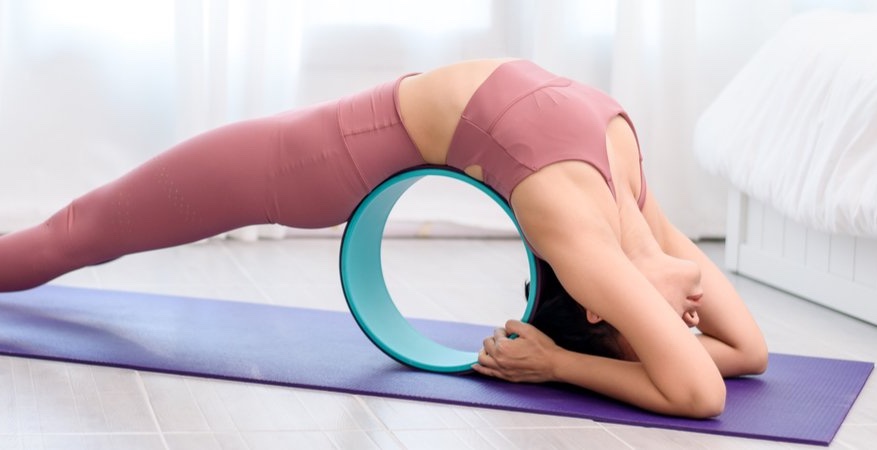
As modern movement practices evolve, so too do the tools that support them. The yoga wheel has emerged as one of the most anatomically informed props in contemporary yoga and physiotherapy. Far from being just a stretching aid, it is a powerful tool for exploring fascial release, spinal articulation, and overall biomechanical efficiency.
Understanding how the yoga wheel interacts with your fascia, nervous system, and joint structures is essential if you want to move from superficial stretches to intelligent mobility. This article offers a deep anatomical and scientific exploration of the yoga wheel’s role in enhancing movement, posture, and recovery.
Fascia 101: The Hidden Matrix of Movement
Fascia is the body’s three-dimensional web of connective tissue that surrounds muscles, organs, and even nerves. Often overlooked in basic anatomy training, fascia plays a crucial role in:
- Structural integrity
- Force transmission
- Joint alignment
- Neuromuscular efficiency
When fascia becomes dehydrated or stiff due to lack of movement or injury, it restricts mobility and creates tension patterns. The yoga wheel offers targeted myofascial release that restores this vital glide and hydration.
How the Yoga Wheel Affects Fascia and Tissue Health
Rolling on a yoga wheel does more than feel good—it mimics the principles of self-myofascial release (SMR), a technique widely used in physiotherapy and sports medicine. Here’s what happens:
🔬 1. Hydration of Fascia
Pressure and rolling stimulate interstitial fluids, hydrating tissue layers and restoring elasticity.
🧠 2. Nervous System Regulation
Slow, controlled movement over the yoga wheel engages the parasympathetic nervous system, downregulating stress and promoting recovery.
🌀 3. Reduction of Adhesions
Fibrous tissue and scar-like adhesions are gently broken down through sustained compression, leading to greater mobility and fluidity.
These responses support why therapists and movement specialists increasingly recommend the yoga wheel for performance and rehabilitation.
Spinal Health: The Wheel’s Core Benefit
The spine is not a rigid rod—it’s a dynamic, segmented column designed for multidirectional movement. Unfortunately, daily habits like prolonged sitting and forward head posture compress its natural curves. The yoga wheel’s curvature directly supports spinal health by:
- Restoring natural thoracic extension
- Decompressing intervertebral discs
- Improving spinal wave motion (essential in many yoga transitions)
Rolling the spine over the wheel improves segmental mobility, encourages neutral alignment, and enhances backbend capability without strain.
Key Muscles and Joints Activated by the Yoga Wheel
Here’s a breakdown of the major musculoskeletal regions engaged when using the yoga wheel:
🔹 Thoracic Spine
Often immobile in modern bodies, this area opens with supported extensions across the wheel.
🔹 Hip Flexors and Psoas
Wheel-based lunges and backbends create a gentle lengthening of deep pelvic muscles.
🔹 Shoulder Girdle
Overhead arm positions on the wheel stimulate external rotation and scapular mobility.
🔹 Core and Pelvic Floor
Unstable poses on the wheel challenge deep core stabilisers, improving proprioception and trunk control.
Scientific Support: What Research Suggests
While direct clinical studies on yoga wheels are still emerging, the principles they operate on are well-supported:
- A 2015 study on self-myofascial release (using foam rollers) showed a measurable increase in range of motion and decreased delayed-onset muscle soreness (DOMS).
- A 2019 review highlighted that tools promoting spinal extension (like the yoga wheel) can improve thoracic mobility and reduce compensatory lumbar load.
- Fascial therapy frameworks, as taught in anatomy trains and modern fascia-focused schools, endorse curved props for tissue hydration and joint decompression.
These findings make a strong case for the yoga wheel’s efficacy in both sports performance and long-term movement sustainability.
Optimising Use: Scientific Techniques and Protocols
To unlock the full anatomical benefits of the yoga wheel, the following techniques are recommended:
- Segmental Spinal Rolling
- Lie on the mat with the yoga wheel under your spine
- Move vertebra by vertebra from sacrum to thoracic spine
- Breathe slowly to support parasympathetic engagement
- Fascial Hold-and-Release
- Find a tight spot (e.g. between shoulder blades)
- Stay and breathe deeply for 60–90 seconds
- Allow the tissue to release before moving
- Active Range Integration
- Combine wheel use with active stretching (lunges, standing backbends)
- This trains your brain to maintain the new range
These techniques help bridge the gap between passive stretching and functional movement.
Combining the Yoga Wheel with Other Modalities
To amplify results, pair your yoga wheel practice with:
- Pilates for core activation
- Fascial release balls for smaller muscle groups
- Resistance bands for isometric strengthening
- Breathwork to enhance tissue oxygenation
Studios like Yoga Edition are embracing this integrative model by offering classes that blend anatomical education with mindful movement, helping students become more attuned to their body’s signals and capabilities.
Frequently Asked Questions (FAQ)
❓ Is the yoga wheel suitable for people with scoliosis?
Yes, though sessions should be guided by a physiotherapist or certified instructor.
❓ Can the yoga wheel replace a foam roller?
Not exactly. While both tools promote myofascial release, the wheel is better suited for spinal and chest mobility, while foam rollers are ideal for broader muscle groups.
❓ How long should I use the wheel each day?
10–20 minutes of targeted movement is sufficient. Consistency is more important than duration.
❓ Does using the wheel improve posture?
Absolutely. It corrects thoracic rounding and pelvic tilts, encouraging upright alignment over time.
Final Word
The yoga wheel is not just an accessory—it’s a biomechanically intelligent tool grounded in fascia science and spinal health. By understanding the anatomy it supports and the techniques it enables, practitioners can evolve beyond surface-level stretching into a realm of informed, functional movement.
Whether you’re an athlete, desk-bound professional, or yoga enthusiast, integrating the yoga wheel into your practice can be a game-changer for mobility, resilience, and long-term wellbeing.
Explore its potential in a structured and guided environment by joining anatomy-aware classes like those offered at Yoga Edition. Here, movement meets science, and insight meets embodiment.